
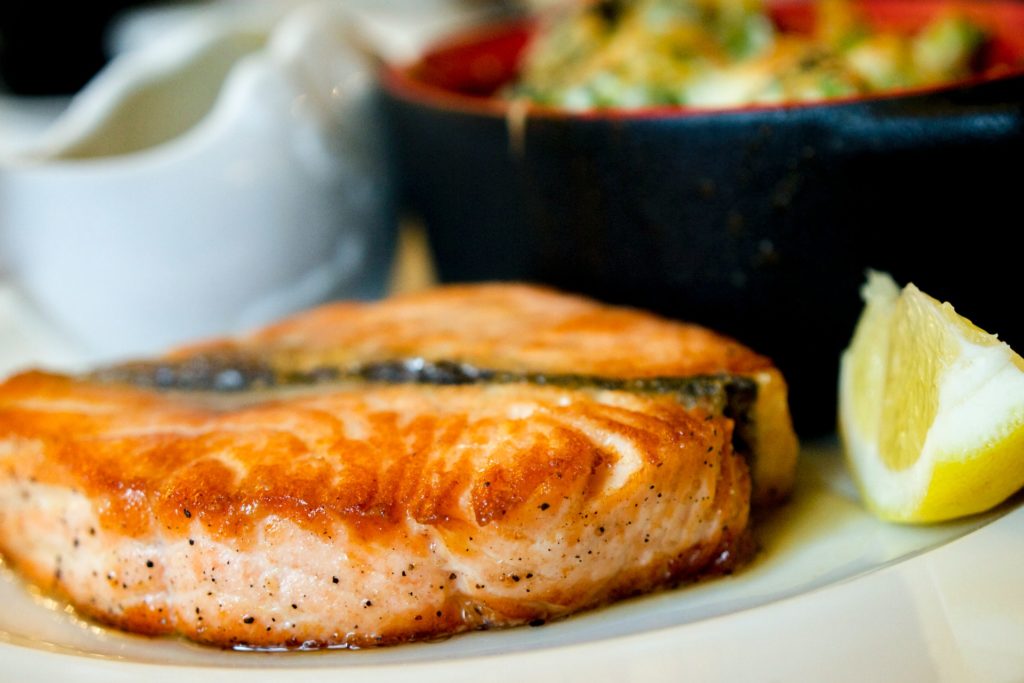
This article lays out a complete beginner guide to cooking salmon fish, with receipts and essential tips. Read on.
Salmon fish cooking can be a little challenging. Still, if you know the basics and cook more and more salmon, these challenges vanish by themselves. For salmon fish, ways to cook are abundant. It is a very nutritious fish, and it is readily available as it is delicious and versatile.
The best and most delicious ways to cook salmon fish include baking, broiling, sautéing, simmering, grilling, and pan-frying on a stovetop. You can also cook and eat salmon fish head in several different ways.
Let us go slowly but thoroughly to describe essential details to help you hit the ground running and cook your salmon fish on the first day.
Ways to cook salmon fish head
Can you eat salmon head?
You can cook salmon fish head and eat it. But you should remove salmon gills before cooking as they are not a good part of the fish because their main task is to filter the water to retrieve oxygen. Thus, they main contain much bad staff filtered from the water.
You can quickly cook and eat the salmon heads. There are many ways to do that, including boiling, baking, grilling, or making a soup from the salmon head. When cooking salmon head, besides removing gills, you also need to remove any extra parts which are not part of the salmon meat. You can leave salmon eyes and eat them once cooked.
Note: the fish head may contain some parasites, more so than in the body. One of the ways to prevent that is to buy previously flash-frozen salmon. If your salmon has never been frozen before, then freeze it in the fridge and keep it for 5-7 days should kill off parasites.
On the other hand, most fish sold in US markets were previously frozen, and salmon is often farmed. Farmed salmon feed an anti-parasite diet and, most of the time, are clean from parasites to the point that it is good enough to be used raw to make sushi.
This section will tell you how to cook a salmon head for a surprisingly enjoyable meal.
What do you do with the head of a salmon?
Even the United Nations says that it is not wise to waste yummy fish heads. http://www.fao.org/news/story/en/item/214442/icode/
Instead of throwing away salmon heads, why not just cook and then eat it?
Note that if you have a cat – cooked small bones are dangerous for them.
1. The simplest salmon heads recipe – salmon head dormitory soup.
- If you are not about elaborate cooking, then here is the simplest way to cook salmon head. Did you know that in many parts of the world, people make soup out of fish heads? You can do it too.
- Remove gills from the salmon head.
- Cut the head in two or more parts, depending on the size of the head.
- Boil water in a relatively large pot.
- You can add salt if you want.
- You may add onions or some spices that you like.
- Throw in some jasmine rice and boil rice.
- Once the rice is cooked, throw in salmon heads or heads.
- Bring back to a boil and simmer on low medium for another 15-20 minutes, until fish is ready.
You just have made a soup with salmon heads. Was not it easy? If you want more, let us dive into cooking some specific delicious ways to cook salmon heads.
2. Salmon heads with rice noodles and soup.
Ingredients
- Salmon heads – 3
- Sea salt
- Sweet wine – 1/4; cup
- Chopped onions – 1 cup
- Sliced chives and chiles
- White miso paste – 1 Tbsp
- Kombu seaweed – 2 pieces, 2 inches each.
- Rice noodles- 1 pack
Procedure
- Remove gills from the salmon head.
- Place the salmon heads in a big pot with enough water to dip them.
- Now add in ginger, onions, kombu, and place the pot on the stove.
- It would take to simmer around 20 minutes.
- Take the broth and remove the salmon heads into a bowl.
- Add mirin to the broth and then add soy sauce and add salt as per taste.
- Cook noodles in salt and water.
- Pour the broth, add miso, and noodle with a salmon head as a topping.
- Cover more broth and add chives and chiles for garnish.
- Serve and enjoy.
Source: https://honest-food.net/salmon-head-soup-recipe/
However, generally, when it comes to salmon, chefs prefer not to use it in soup but to roast or bake it.
3. The roasted salmon head
Ingredients
- Salmon head- large
- Lemon
- Chopped onions-1 cup
- Grill rub or homemade seasoning
- Aluminum foil
- Chopping board, knife
- Rice noodles- one pack
- Oil
Instructions
- Remove gills from the salmon head.
- Cut the salmon heads in half. Everything besides gills is edible in the salmon head.
- Rub the packaged or homemade rub over it to make it sweet, a bit spicy, and salty.
- Rub the seasoning over the parts on all sides.
- Place the salmon head with skin on a baking sheet that is covered with foil.
- Preheat the oven to 250-400F (120-205C), with the average being 180C (350-375F).
- Place baking sheet with salmon heads in the oven.
- Bake them at 250 degrees F for 40 mins or at 400 degrees F for 10-15 minutes. Time is based on the head size as well.
- Now turn the oven heat to 450 deg F. Flip the salmon head.
- Cook for 8-20 minutes more or until it is brown and crispy.
- Serve with a slice of lemon once the meat is ready.
- Serve on a large platter with rice and green beans to enjoy.
Source: https://guides.brit.co/guides/cook-a-roasted-salmon-head/particle-8
Rough total baking estimation of time for an average salmon head is as follows:
| Temperature | Baking Time |
|---|---|
| 250 F | 35-45 minutes |
| 300 F | 30-40 minutes |
| 350 F | 20-30 minutes |
| 400 F | 15-20 minutes |
Note: if you use an air fryer for cooking salmon heads, then the timing and temperature regime will be like that above. Source: https://thetopmeal.com/roasted-salmon-head-recipe/
4. Garlic and butter broiled salmon heads
This recipe is based on Filipino recipes.
Ingredients
- Butter- ½ a brick
- Salmon head -1
- Garlic cloves – 8-10
- Broiler or conventional oven with broiler
- Chopper or good chef’s knife.
Instructions
- Clean the salmon heads cautiously.
- Rinse them in cold water.
- Eliminate the gills and set the head aside.
- Make use of a food processor for thorough garlic cloves chopping. Or use a good chef’s knife to make your life a little bit harder.
- Add the room temperature butter to the chopped garlic and chop them together to make a paste.
- Add in herbs and spices, and salt (if using unsalted butter)
- Spread or place the butter and garlic on both sides of the fish head.
- Preheat to the highest setting in the broiler.
- Place the fish with eyes side up for even and fast cooking.
- Keep checking for around 5 minutes periodically.
- The butter begins to melt around 5 minutes, and garlic browns up.
- Now spread the melted garlic and butter mixture over fish with a long brush or spatula again for even spreading.
- Cook for another 2 to 5 minutes.
- Flip the fish head and cook the other side the same way also for 2-5 minutes.
- Eyes are also edible.
Source: https://cookingwithstellaaa.wordpress.com/2013/01/30/garlic-and-butter-broiled-salmon-heads/
Below is one of the most popular recipes for baked salmon heads.
5. The salmon heads with potatoes
Ingredients
- Salmon heads – 2-3
- Fresh dills – 1/3 cup
- Whipping Cream -1/2 cup
- Bay leaves – 2
- Onion- A large size
- Kosher salt- 1 tsp
- Potato cubes- 2-inch cubes- 8 oz or about 3 medium potatoes.
- Are you feeling lazy? You can cut potatoes into few large pieces each instead of cubing them.
- A little bit of butter for frying.
Procedure
- Melt some butter in a pan on medium heat.
- Pan fry added onions until soft for 5-7 minutes.
- Add salmon heads, potato cubes, bay leaves, and dill leaves.
- Add in water to just enough to cover everything and bring to simmering temperature.
- Cook until the fish heads and potatoes are tender. It may take about 20 minutes.
- Take the fish head and split the edible parts from the skeleton without breaking them into pieces. (Optional, you can have leave whole heads if you want)
- Add these parts into the broth. (optional)
- Add in cream and chopped dill with some salt and pepper.
- Serve, and it can be stored in the refrigerator.
You can add other ingredients into this receipt – carrots, broccoli, cauliflower, for example, can be cut and thrown in to cook along with potatoes.
Source: from Serious Eats
6. The salt grilled salmon head
Ingredients
- Salt -1/2 tsp
- Salmon head- ½ – 1
- Lemon slices – several
Procedure
- Dry head after washing carefully. Pat dry with a paper towel. Using hair drier only if you keep drier away from the fish to avoid it start cooking a little.
- Prepare grill. Use aluminum foil to line the tray for grilling. Put in the racks. Now preheat the grill to 400 F or 200 C temp.
- Sprinkle salt on the slit side of the salmon head. Sprinkle all over the fish.
- Grill till it is somewhat charred for about 8 minutes.
- Once the fat begins to spit and bubble, turn the head to the other side and sprinkle the salt.
- Grill this side as well until it is charred a little. This site will also take around another 8 minutes.
Adapted from http://kitchentigress.blogspot.com/2011/02/salt-grilled-salmon-head-kabuto-yaki.html
How to prepare salmon fish in the oven?
You can cook salmon fish in the oven by baking it. Baking is probably the best way to cook salmon fish. Baking in the oven is identical to broiling. It is easy to make a quick and perfect salmon.
Baking salmon fillet is one of the best methods and is a primary way to prepare salmon fish in the oven.
Using one large fillet is better than trying to cook several small ones. There are some pre-preparations to be done before proceeding to bake it in an oven.
How to cook salmon in the oven? Starting tips.
- Take the large spatula, large enough for lifting and turning a good portion of the fillet, lift the fillet, and transfer it to a platter (the whole thing). It would help if you got spatulas meant for this purpose because you will need them for baking.
- Take preferably a cast iron pan which is suitable for searing fillets and putting them into the oven. A non-stick pan that can go into the oven and sustain its heat is also good. But cast iron transfers heat better.
- A small plier, needle-nose type, does an appropriate job of yanking the pin bones. Get it if you cook fish often. Strong tweezers could be used; however, they are less efficient in doing the job.
- You may bake salmon or other fish in aluminum foil. Foil traps the moisture, reducing fish dry-out, and keeps the flavor in. Have aluminum foil or parchment paper on hand.
- Note that wrapping salmon in foil results in a kind of steaming-baking salmon fish combination.
- Many blogger chefs recommend using parch paper if you do not have or do not like aluminum foil. The foil or parchment paper makes it easy to line up and makes cleaning easier. I personally never tried parchment paper when baking salmon.
- It helps to remove bones from salmon for a better overall experience unless you buy a boneless fillet.
- Get salmon fillet. There is no need to mess with cutting salmon fish unless you want to do it yourself. If you missed the fillet into smaller pieces or slices before cooking, it would cook slightly faster, and You will be able to serve it right away.
What is the best temperature to bake salmon?
As a rule, you can bake salmon at a temperature in the range of 325-450 degrees F, with 400 F being the average consensus temperature level. A higher temperature will cook salmon faster. I like to use high temperatures for cooking my food faster.
Also, large salmon fish or fillet size may require higher temperature settings than smaller fish or pieces of salmon.
How long should I keep salmon in the oven?
As a rule, you should cook salmon fish for about 5 minutes per half an inch of thickness at about 400 F – 450 F degrees. So, for a 2-inch-thick salmon fillet, it should take about 10-12 minutes to bake. Just make sure you preheat the oven to that temperature before putting salmon.
Other chefs roughly estimate that it takes about 1 minute baking time per 1 ounce of salmon. It means 5 minutes per 5 ounces or 10 minutes per 10 ounces. Therefore, the large the salmon is, the longer you should keep it in the oven.
A rough estimation of the time necessary to bake salmon in the oven:
| Average Temperature | Approximate Baking Time |
| At 325 F | 30-45 minutes. |
| At 350 F | 20-35 minutes. |
| At 375 F | 15-20 minutes. |
| At 425 F | 12-20 minutes. |
| At 450 F | 10-20 minutes. |
7. A basic general recipe for cooking salmon fish in the oven.
- Preheat the oven to a desired baking temperature.
- Pat salmon dry with kitchen or paper towel.
- Spray it with some salt and pepper.
- Line baking sheet or baking pan with aluminum foil.
- Put salmon on it and place in the oven.
- Bake the fillet skin side down for 10-25 minutes, depending on the temperature selected.
- Season with garlic, thyme, and honey, or anything else you deem necessary.
Should salmon be baked covered or uncovered?
It is not required to cover salmon when baking it in the oven. But covering salmon when baking may speed up the cooking process, and salmon may cook slightly faster than when left uncovered. Covering salmon also may help to trap moisture in the salmon fish.
For example, when you want to cook it in foil or parchment paper, you wrap it. But note that wrapping salmon fish in foil may result in a longer cooking time.
Alternatively, you can use an oven-proof baking dish for baking the salmon.
8. Oven-baked salmon tasty recipe
Ingredients
- Salmon fillet – 12oz. Cut into four pieces.
- Salt
- Black pepper- Freshly ground
- Almond toasted- 1/2 cup
- Parsley Salsa
- Baked squash
- Red wine vinegar
- Shallot-1
- Capers-2 tbsps
- Fresh flat-leaved parsley-1 cup
- 1/2 cup toasted almonds
- Olive oil- Extra-virgin
Procedure
- Preheat to a temperature of 450 deg F.
- Season the fish with pepper and salt.
- Position the salmon skin side downside over a non-stick baking sheet. You can also use a non-stick pan with an oven-proof handle.
- Bake until cooked all through to around 12-15 minutes.
- Serve with squash and parsley salad made by mincing shallot, vinegar, and salt to let it sit for around 30 minutes to an hour. Chop the parsley, capers, almonds. Blend these in the above mix. Add in olive oil, mix, and add in seasoning.
Adapted from https://www.foodnetwork.com/recipes/oven-baked-salmon-recipe-1911951
How do you know when salmon is done in the oven?
Salmon is ready when the fillet is opaque and pink and maybe slightly overcooked if it already flakes easily with a spoon. That moment between being fully cooked and overcooked is hard to catch for a newbie.
First, salmon gets pinky, then opaquer. Then, ff you press firmly with a spoon, and the meat starts pulling apart. Then it is ready.
Note that it keeps internally cooking for several minutes after you remove it from the oven.
So, take a fork or even a spoon, open the oven, press firmly on top of the baking salmon. It is ready or even overcooked if it flakes easily when pressed.
Salmon must reach an internal temperature of 135-145 F degrees to be fully cooked on a well-done level.
Also, suppose you check with an instant read thermometer in the thickest part of the salmon, and that part shows 140F degrees. In that case, many chefs say they remove fish from the oven right away to avoid overcooking it. Some chefs say that reaching 135 F degrees is enough for a well-done salmon.
Source: https://www.wikihow.com/Tell-when-Salmon-Is-Cooked
How do you keep salmon from drying out in the oven?
Salmon fish may often dry out when cooked in the oven. There are few methods you can use to keep salmon from drying out in the oven.
- Brush salmon with oil to cover lightly, and it will keep it moist.
- Keep salmon very tightly wrapped in aluminum foil or parchment paper to trap moisture. It may take a longer time to cook it this way.
- Bake salmon in a closed oven-proof baking dish to trap moisture.
- Bake it on no more than 350-375 F degrees to avoid too much drying out, essentially roasting it.
- Note that baking salmon on low will take a noticeably longer time, but salmon will keep much of its moisture in the end.
- You can bake salmon fish on as low as 225F – 250 F degrees to trap most moisture.
- Another technique is to freeze the salmon and then bake it straight from the frozen.
- A combination of some of the above methods should have an even better effect.
Different ways to cook salmon fish
Let us talk more about salmon fish and ways to cook it without a sweat. Other methods of cooking salmon can be broiling, stovetop pan-frying, grilling, poaching, and so on. So, let’s dive into different ways to cook salmon fish.
Cooking salmon fish on a stovetop
You can cook salmon on the stovetop and in a pan by sautéing, pan-frying, or poaching.
9. Boiling salmon on the stovetop.
You can boil it, but this method is quite bland, and we will not discuss boiling here as discussed above in the soup-making section. Boiling salmon is good if you want to make salmon soup.
You bring pot with water to a boil, through in salmon or pieces of salmon, add salt, pepper, seasonings, and boil salmon until ready.
It takes anywhere from 10 to 15 minutes to boil fish. We discuss a similar process below in the poaching salmon section.
Otherwise, cooking salmon on a stovetop is the easiest and quick way to pan-fry or sauté it. Poaching generates a clean-tasting tender salmonю
How to cook salmon in a pan?
Sauteing and pan-frying are somewhat the same, except sauteing means cooking quickly on high heat with very little oil or butter.
When you pan-fry salmon, you get crispy skin and golden crush which is fantastic to eat.
Salmon pan-frying tips:
- Use good quality clean medium-sized pan.
- A medium-sized cast-iron skillet is even better for frying because iron accumulates and transfers heat better.
- Brush salmon fillet in olive oil before frying.
- Fry over medium heat to avoid drying salmon too much.
- Fry only on preheated hot pan or skillet.
- The skin side takes a couple of minutes longer to cook when fried.
- Use the only fillet at room temperature. Do not use cold, and especially frozen, fillet for pan-frying. About 30 minutes at room temperature out of the fridge is enough. Completely thaw salmon before frying if frozen.
- Pat dry salmon fillet with a paper towel.
- I prefer frying anything in olive oil, but you can use butter too.
- Be careful as hot oil may splatter. Use glasses or splatter screens.
10. The most straightforward fried salmon recipe with instructions!
- Take a salmon fillet and brush it with olive oil.
- Put a thin level of olive oil in a pan or skillet to cover the bottom.
- Put pan or skillet on medium-high heat on the stovetop.
- Preheat. When oil shimmers and starts sizzling and covers the bottom of the pan or skillet, put salmon in, skin side down.
- You may turn the pan or skillet around to make sure the oil completely covers the bottom.
- Sear on medium for about 6-8 minutes.
- Then use a spatula to flip the salmon fillet over the skin side up.
- Now sear for another 3-4 minutes.
- Now, when salmon is pink and opaque, it starts to flake when you press on it – it is ready, and you can take off the pan or skillet.
- Put it on a plate and let it sit there for 4-5 minutes while it finishes cooking internally.
- Spray some lemon juice over it, seasonings, and serve.
11. Tuscan Butter Salmon
- Take a cast iron or non-stick skillet on medium-high heat. Coat the pan with the bit of oil of your choice. It could be butter, olive oil, or veggie oil.
- Let the pan heat up.
- Place the salmon fillet skin side up. Enjoy the sizzle.
- Cook it till the filets release naturally when flipped or moved with a spatula.
- Do not force with a spatula as the crust is still forming.
- Once the crust is formed totally in around 6 minutes, you flip the fillet.
- Let the skin get crispy and nice post-flipping to around 4 extra minutes.
- This should cook the fillet inside out. If not, pop the skillet into an oven preheated to 350 deg F. Roast it for around 5 minutes.
- Your salmon is ready to serve and enjoyed.
12. Sautéing salmon fillet
You can also sauté salmon fillet over a high flame, resulting in the best, fast and easy fillets.
Procedure
- Melt just a little bit of butter, about a tablespoon, in a non-stick skillet on medium-high heat.
- Cook it till the foam subsides, and it turns golden in color. This will take around 3 minutes.
- Turn heat on high.
- Season the salmon fillet with pepper and salt.
- Add to the skillet or pan skin side upwards.
- Cook for around 5-6 minutes on one side till the fillet turns deep golden brown.
- Flip the fish and cook for 2 to 4 minutes longer.
- Cook and check for its doneness.
13. Poaching Salmon
Poaching provides you with cleaned, cooked salmon, which is the right way to get no added fat fish. Poaching is a simple way to make sure moist and nice salmon every time. Similar to boiling, poaching, nevertheless, is different.
Procedure
- Season the fillets on both sides.
- Take a large skillet, bring a cup of dry white wine and a cup of water.
- Fill water as much as to cover a salmon fillet.
- Now add salmon.
- Sprinkle some salt, add a bay leaf and peppercorns.
- Bring it to a simmer.
- Turn off the heat.
- Cover the skillet tightly and let the fish self-cook for around 20 to 30 mins.
- This will result in medium-rare salmon. If you want it well done, turn it down to low instead of turning it off completely. The salmon should cook within 10-20 minutes to a well-done level.
- Remove the salmon cautiously with a spatula.
- For additional flavor, season it with garlic cloves and herbs like fresh dill in the skillet.
- As per FDA, salmon ought to be cooked to an internal temperature of 145 deg F. When done, check for it using a fork instead of a thermometer.
- Check at the thickest part of salmon to make sure meat is cooked and starts falling apart when pressed.
Adapted from https://cooking.nytimes.com/guides/19-how-to-cook-salmon
Broil Salmon
Broiling salmon is the easiest and simplest of techniques.
14. Broiled Salmon Horizontal
- To begin with, preheating the broiler too high.
- Place it on an oven rack to make sure that salmon is within several inches of the source of heat.
- Position the fillets on a baking sheet or an aluminum foil to avoid sticking.
- Season the fillet all over with pepper, salt, and other seasonings.
- You can use garlic, grainy mustard, herbs.
- Broil five to eight minutes to make sure it is cooked.
- The salmon top will become brown to indicate readiness.
- Check for doneness using a fork or spoon.
Adapted from https://cooking.nytimes.com/guides/19-how-to-cook-salmon
15. Grilling Salmon
If you are looking for some smoky flavor and some char marks.
Procedure
- Season your fish and preheat the grill on medium-high heat at 350 F degrees or more.
- Oil the grates to make salmon easy to flip.
- Add the salmon to the skin side and cook on the grill for around 5-8 minutes.
- Grill until the bottom fish half appears opaque and easy release when flipped.
- Flip it over.
- Grill after flipping for about 4-6 minutes longer.
- Place the salmon over the foil.
- Check for doneness.
- You can also choose flavor components and veggies.
- You can use veggies like asparagus, bell peppers, zucchini, sliced potatoes, and onions.
- Season with pepper and salt.
- Cook until tender.
Adapted from: https://www.delish.com/cooking/a19856198/how-to-cook-salmon/
Tip: a trick to keep moisture in salmon when grilling is to cover it with olive oil and set the grill on high temp (450 F – 500 F) to cook quickly before moisture comes out. You can also wrap it in foil to keep moisture in when grilling. Marinating salmon may also help salmon to retain moisture on the grill.
Marinating salmon for grilling.
You can marinate salmon for 30 minutes in the mixture of olive oil and lemon juice with some herbs before grilling. Marination will make salmon softer, juicier and it may cook on the grill faster.
Source: https://rasamalaysia.com/grilled-salmon/
16. Way to grill skinless salmon fillet.
You can grill salmon’s fillet in foil or without foil. Here is how you can grill skinless salmon fillet in foil the easy way.
- Get skinless salmon fillet.
- Brush it with olive oil, spry seasonings on it.
- Preheat grill to 350 F – 450 F.
- Tightly wrap salmon in foil and place it on the middle rack of the grill.
- Grill for 15-20 minutes, depending on the temperature and size of the salmon.
Should I flip salmon on the grill?
You should flip salmon on the grill because, unlike the oven, heat distributes unevenly in a grill. Flip once in the middle of cooking, as soon as one side is cooked.
FAQ
How long does it take for salmon to be cooked?
Usually, it takes on average 4-6 minutes cooking time per ½ inch of salmon thickness or about 1 minute per 1 ounce of salmon fish. This is especially true for the salmon fillet.
According to FDA, fish, including salmon, is cooked when its internal temperature in the thickest part reaches 145 F degrees.
Source: https://www.fda.gov/food/people-risk-foodborne-illness/meat-poultry-seafood-food-safety-moms-be#:~:text=Finfish%20s
You can use an instant thermometer to stick it in the thickest part and measure temperature while still cooking. Be careful, it is hot, and it is still cooking.
Note that once you remove fish or other food from the oven, frying pan, or grill, it still cooks internally for a few minutes while cooling down.
How do you tell when salmon is done cooking?
Salmon flesh must become pink, opaque and meat must start pulling apart when pressed even with the spoon. If it flakes easily with the fork, it is cooked and is on the verge of overcooking.
Also, salmon is done cooking if the internal temperature reaches 145 F degrees in the thickest part. Note, this rule is valid only if all salmon parts were cooked evenly.
Chefs recommend stopping cooking salmon as soon as it reaches 140 F degrees in the thickest part.
How do you cook salmon without drying it out? How do you keep salmon moist when cooking?
Cook (roast) it either on very low heat at about 230-250 F. Or cook it fast on high heat before salmon loses much moisture. You can also keep salmon moist with preliminary preparations such as brushing with olive oil and tightly wrapping salmon fillet in aluminum foil.
Do you eat the skin on salmon?
You can eat salmon skin because it cooks well.
Final word
There are about million more ways to cook salmon. But now you know most basics of different ways to cook salmon fish.