
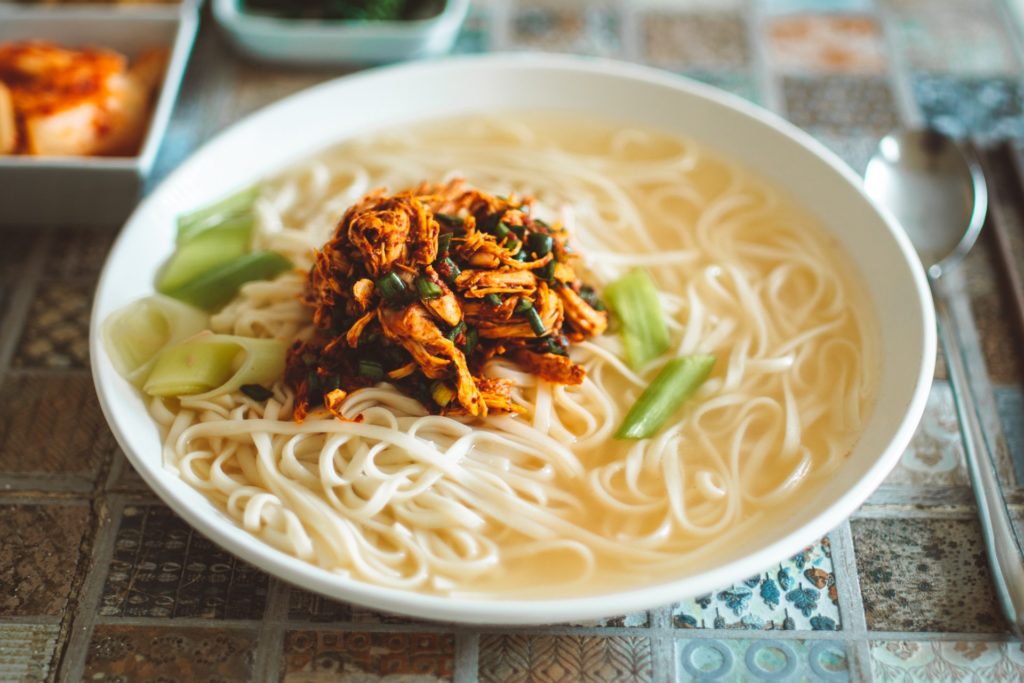
Dried and commercial rice noodles can be readily purchased. However, making rice noodles fresh at home is a healthy, tasty, and fun way to do it. Rice noodles essentially are a light chewy pasta alternative. They are quite commonly used in cooking Southeast Asian food.
Homemade rice noodles can be made easily with some easy-to-follow steps. In this article, you will know how to make rice noodles at home step by step from scratch and to cook it right.
A little about making rice noodles
Rice flour is used to make rice noodles. They are gluten-free naturally, transparent, and gelatinous in texture. Tapioca or corn starch is added when making rice noodles to add in that additional chew. Also starch helps noodle dough to be firmer so that you could roll it.
Without starch, rice dough may be too liquid and it may be hard to create a shape out of it. They can be made as strings or as flat noodles. They are available in different textures and shapes too.
Rice noodles are a great lunch/dinner add-on with low-calorie content. They are healthy, clean, and lean. Enjoy the best with fresh veggies and much lean protein to make it even healthier. You can add them in broth or season them and eat them.
Rice noodles are healthier than regular pasta owing to their fiber, calorie, carbs, and fat content. They are sugar and cholesterol-free. It has 103 mg of sodium in each serving. It has higher folic acid and iron content.
You can make rice noodles from brown rice or white rice. Brown rice noodles are made from whole grain and are a healthy option for your next homemade dinner.
It is fair to note that making rice noodles is probably a little more complicated than, say, cooking salmon fillet or even making a homemade pizza. In a way.
To get the best out of this article, read steps at least several times and read them carefully. Then you will understand how to make rice noodles at home.
Quick facts: health advantages of rice noodles
- Rice noodles are ideal for gluten-sensitive people or people with celiac disease. This is because it is gluten-free.
- They are abundant in Selenium and Manganese. Selenium is an antioxidant while manganese is a blood sugar-regulating mineral.
They are abundant in phosphorous, a mineral for storing and using energy.
How to make rice noodles at home?
Here we will talk about two primary methods, however, both have several steps in common. Both the methods are easy and will result in delicious, soft, and fresh rice noodles to treat yourself, your family, or guests.
Before we go deeper into more details, here is the first and easiest birds view method offered in one of the comments on the internet:
- Soak rice for 24 hours
- Then work it with blender as much as possible.
- Then add a good amount of starch and water for a firm dough-type of consistency.
- Then use a noodle machine or simply flatten the rice noodle dough into one or more thin sheets.
- Then boil each sheet in a pan for about 5 to 9 minutes. Some recommend bringing water to boil and then taking the pan with that water off the stove and soak rice noodles in it.
- Prepare cutting board properly brushed with olive oil while sheets are still boiling or soaking.
- Then take out these boiled or soaked rice sheets on the cutting board.
- Cut those sheets into noodles the way you want. You can cut them thin or thicker or flat. The thinner the sheet is the thinner the noodles will come out.
This is a rough overview of the process to make rice noodles at home. Below are two more detailed methods on how to do it.
Recipe for Homemade Rice Noodles - The First Method
It makes noodle sheets for flat, thin, or any other size or shaped rice noodles. Here is the recipe for homemade rice noodles step by step with the cooking and serving times. This will serve you as a guide to make rice noodles from scratch.
Preparation time – 35 minutes
Cooking time – 45 minutes
Serves – 6 people or makes 5 noodle sheets
The total process takes – 1 hr 20 mins
Things you will need:
- About 6 to 8 quarts pan with a flat bottom in which you will make rice noodle sheets. Pan is a preferably rectangular or square shape, rather than round. You can get a glass heat-resistant baking pan (glass bakeware) in most stores or online.
- Mixing bowl (large is better)
- Wok pan or other cooking vessels (large pot, etc.) in which you must fit that glass pan above
- Brush for oil could be useful
Glass bakeware is better as it does not change the flavor of ingredients. It is slow to heat up but retains heat well. On the other hand, metal one will never shutter.
Glass bakeware may shutter but in rare cases of direct overheating or after being tampered with. For making rice noodles it should be fine though. If metal – opt for classic metal or stainless steel. I do not like aluminum for many reasons beyond the scope of this article.
Wok pan can be used for numerous other recipes besides making rice noodles. It is even more useful if you live in your own house – can cook some food on the open fire in your backyard. But you can skip the wok and use something else instead.
Ingredients you will need:
- Rice Flour – 1 1/4; cups
- Corn Starch or Tapioca Starch- 2 tablespoons
- Salt -1/2 teaspoon
- Water -1 1/4; cups
- Vegetable oil – 1 teaspoon
- A little bit of oil for brushing
NOTE: You can use the following types of starch – corn, tapioca, potato, legume (pea, bean). Combining different types of starch is generally ok.
Did you know that in Asia they research rice noodles?
For example, one research suggests that using more tapioca starch vs. potato starch increases transparency, reduces the stickiness and cooking loss in rice noodles, and gives the product a moderate elastic structure.
And legume starch is better for maintaining the shape and elasticity of the noodles, but corn or tapioca starches are better for that nice chewy structure. Source
Nutritional Value/Facts
- 29g or 10%- Carbohydrates
- 137kcal or 7%- Calories
- 1g or 2%- Fat
- 2g or 4%- Protein
- 1g or 5%- Saturated Fat
- 25mg or 1%- Potassium
- 196mg or 8%- Sodium
- 1g or 4%- Fiber
- 3mg- Calcium
- 1g or 1%- Sugar
- 0.1mg or 1%- Iron
Procedure and Step-by-Step Instructions: 18 steps to make rice noodles
Step 1- Add tapioca starch and rice flour to a mixing bowl. You can substitute tapioca starch with corn starch as well. Add starch, rice flour, salt and mix them.
Step 2- Now add in water gradually. Mix all the ingredients well until all the components are well dissolved.
Step3- Add olive oil, about a teaspoon to this mixture. Strain this blended liquid using a fine-meshed strainer into a different bowl.
Step 4- Cover this bowl of liquid and let it sit for about 30 minutes.
Step 5- Fill a wok with water. Ensure that a pan with a flat bottom that fits inside easily is taken. For people who do not have such wok, make use of a deep and large cooking vessel that has a wider opening with a lid. Place it on a stovetop.
Step 6- Bring it to a boil and if needed add in more water during the process of cooking. The pan should float on the boiling water.
Step 7- Take little oil and brush a light coat on the bottom portion of the pan. Put this pan on the boiling water.
Step 8- Add in 1/4 cup of the rice liquid that you kept for resting to the pan. Tilt the pan in such a way that this rice liquid spreads and covers the pan’s bottom portion.
Step 9- Cover the wok or pot with a lid. Cook it for 5 minutes on high heat. For a thicker bottom pan, enhance the cooking time to 7 minutes or 8 minutes.
Step 10- Meanwhile, coat another pan with oil lightly and keep it ready. Remove the covered lid after 5 or 7 minutes according to the pan and keep it aside.
Step 11- Place the 2nd pan in the wok over the boiling water just as in the first one. Now add in 1/4th of a cup of rice mixture. Tilt the pan to cover the bottom portion of the pan. Cover the lid and let it cook for the same time as the first one.
Step 12- Place the noodle sheet on a cutting board. Before placing the sheet, lightly coat the board with little oil to avoid any sticking.
Step 13- While the second one is cooking, take the first pan and lift the sheet gently. This is the rice noodle sheet ready and fresh. Lift the noodle sheet from the pan by gradually loosening its sides by making use of a rubber spatula. Gradually lift it off the pan. Place it on the cutting board.
Step 14- Your second sheet is ready by now. Brush the first layer with oil and then repeat step 13 and place the second sheet over the first layer that was coated with oil. This will avoid any sticking. Two of your rice noodle sheets are ready.
Step 15- Get ready for the 3rd batch and over in the same way as above. Grease the pan, place it over the boiling water, pour the rice liquid and cover the bottom portion of the pan. Repeat these steps until the entire rice batter is run out.
Step 16- Once all the noodle sheets are ready and placed over one another post-oil coating. The noodle sheets are cut to the shape you want. For flat noodles, slice to about 1/3 inches wide pieces.
Step 17- Separate each layer gradually and gently. They will separate easily as the layers were oil coated. Toss the noodles separately. Once the cutting is done, fresh rice noodles are ready to use.
Step 18- Your fresh rice noodles are ready and made at home. You can either cook them right away or store them in the fridge. You can repeat the process as and when required and to whatever amount by preparing the adequate batter to get fresh noodles every time.
Rice Noodles Storage instructions
The rice noodles that are freshly made can be stored in the fridge for one or two days. You can expect some hardening of the noodles. However, they will be back to normal once they heat. Your homemade rice noodles are ready to cook and be stored.
Still, some recommend that they be stored at room temperature for better taste. Source
How to use the rice noodles made at home?
The rice noodles made at home from the scratch are ready to eat post steaming. They can be added to soups, stir-fried, added with chicken, or with veggies.
Some tips to help to make rice noodles at home easily and appropriately:
- When making noodle sheets with rice batter, you stack one noodle sheet on the top of the other noodle sheet. The key is to avoid any sticking of one noodle sheet to another. When layering the noodle sheets, always ensure the entire noodle sheet surface is coating with oil evenly and lightly.
- Having two pans with flat bottoms is preferable. It could be a Pyrex pan or a baking pan. This is only to save time and ensure your work is done without any gaps or wasting boiled water or fuel. It is good and quick.
- Add the rice batter mixture to the pan with a flat bottom to save on the cooking time as well. A thicker bottom pan will take a longer cooking time.
- Make sure the flat bottom pan is placed over the boiling water. The pan should be even in level over the boiling water. This is because the noodle sheet is covered evenly in thickness without one side thick and the other side thin.
- A pan of 7×7 inches is best in size. However, you can use it according to your recipe and serving quantities.
- Always stir the rice batter before adding or pouring in the pan as the rice flour settles down with water floating over on the top. Mixing ensures a rice noodle sheet at the final stage.
The second method to make string rice noodles
This is another method to make rice noodles at home. The recipe shared below makes around 3 pounds or 8-10 cups of cooked noodles. This method makes use of a dough mixer and potato ricer to make the process of noodle making easier.
Things you need and ingredients:
- Rice flour – 4 cups and a little for dusting
- Water – 3 and a half cups
- Canola or shallot oil– 3 tablespoons
- Tapioca starch -1 cup
- Potato ricer
- Dough mixer
Procedure and Step-by-Step Process for the second method of making rice noodles
Step 1: This step is the same as in the first method but the only difference here is you do not need to add in tapioca starch at this moment. Add rice flour and water and make a blend by whisking it. The blend of rice flour and water is however covered and fermented for 4 days at room temperature for a tangy flavor.
Step 2: The fermented rice flour blend has settled rice flour at the bottom with water separated on the top. Eliminate this separated water by pouring it out.
Step 3: Add in freshwater, about 1/4th cup to this batter. Whisk or stir till it blends properly and becomes smooth.
Step 4: Take water and add salt to a large stockpot. Let it boil over high.
Step 5: While it boils, prepares the dough. In a 4 to 6 quarter pot, add oil and heat it over high. When the oil is heated, add in rice batter and turn it to low heat.
Step 6: Take the help of another family member to stabilize the pot while the other stirs the batter with a wooden spoon firmly.
Step 7: Dough gradually thickens and cooks. Let it cook for good 5 minutes to 8 minutes. Once it becomes a firm and thick paste, then it is done. If a little dough is stuck to the sides, then leave and do not scrape and add it into the dough.
Step 8: Transfer this cooked dough into a mixer with a dough hook. Now add in tapioca or corn starch at this point. Mix it for 10 minutes at medium speed. Make it a sticky ball.
Step 9: Boil water and keep it simmering by adjusting the heat. Dust the work surface with flour. Transfer the sticky ball over the dusted surface. Knead it well to around 5 minutes. This makes the dough smooth.
Step 10: Cover this dough with cling wrap to avoid any drying.
Step 11: Create an ice-water bath and place it close to the stove. Take potato ricer and place a little dough into it. Position the ricer bottom over the boiling water in the center. Now push the rice noodle into the water by pressing it smoothly. Shake to release the ends free.
Step 12: Simmer to 1 and a half to 2 minutes in boiling water. Take tongs or spider and transfer the noodles to an ice-water bath. Later drain them and let them rinse under cold water to eliminate extra starch. Repeat the process with the rest of the dough.
This method gives string rice noodles. Storage is the same as for the above method.
Tips to follow:
- Water and rice flour are blended and then cooked until thick over a stovetop. This step helps to get rid of the raw rice flour taste.
- Once the rice flour paste thickens, you need to stir continuously. You can take the help of your family member to assist in holding the container/cooking pot down during the stirring process. This will avoid lump formation.
- The noodles flavor improves once the rice-flour blend ferments for 4 days at room temperature. This step is optional, but it surely does add in a tanginess to the overall finished noodles. If you want to skip this step and, in a hurry, then soaking it overnight is recommended.
Conclusion
This is how to make rice noodles at home. By following the steps carefully and with tips, you will be able to make string or flat noodles or noodle sheets quite easily and fresh right at home. These rice noodles can be used right away or stored in the refrigerator for a day or two.