
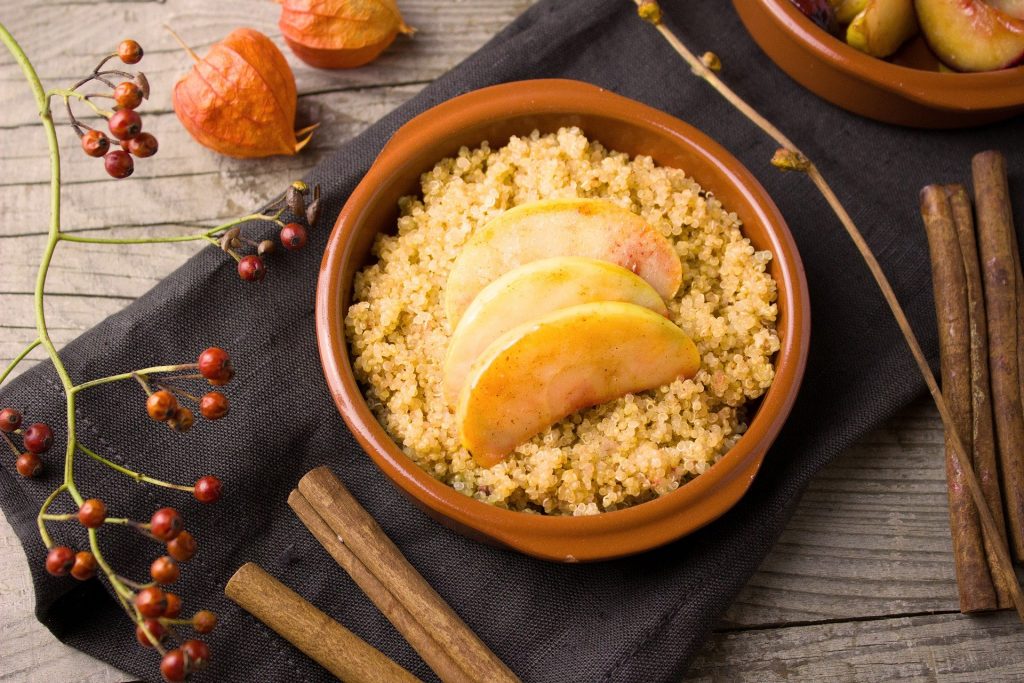
What is Quinoa Origin?
Quinoa origin is in South America and has spread over the world. Below we discuss in more details where exactly it came from and why quinoa is such a great and popular source of food all over the world. We even describe history of how Inca’s emperors made quinoa a crop of choice for ancient native South American civilizations.
Quinoa is often referred to as a cereal. However, the edible products of this plant are actually fruits rather than grains, and scientists classify quinoa as a pseudo-grain crop. This pseudo cereal is mainly grown as a crop for its seeds.
Quinoa seeds are high in protein, carbohydrates, ash, and food fibers as well as vitamins like vitamin A, B vitamins, vitamin C, vitamin E and choline.
They also possess the following microelements and minerals: potassium, calcium, magnesium, zinc, selenium, copper and manganese, iron, phosphorus and sodium. Although from the scientific point of view it is a fruit, Quinoa has no equivalent nutrient value.
It is often used in vegetarian meals and can be used in any recipe that requires the use of rice or couscous. Two very important advantages of quinoa are high protein content and its absolutely gluten-free nature. Both help make quinoa an indispensable product for vegans and people who are unable to tolerate any foods containing gluten.
Quinoa seeds possess protein of higher caliber in larger amounts than other cereals. They also have greater lysine content than wheat. Much like casein, quinoa is also known to contain enough amino acids for a healthy nutrition balance for both animals and humans.
Quinoa Origin
Quinoa is a grain crop and a member of the Amaranthaceous family which grows on the slopes of the Andes in South America. Quinoa is of ancient origin and served as one of the ancient Native Americans’ most vital food sources.
Quinoa, along with corn and potatoes was one of the three main foods of the Incan civilization. Its importance has not diminished as it remains an integral staple for the Incans’ indigenous descendants, the Quechua and the Aymara.
Legend has it that the Inca emperor solemnly planted the first seeds of quinoa every year. Disc-shaped fruits of different colors were consumed in the form of cereals or flour, and young green leaves were consumed fresh. Inca called quinoa gold grain.
In the civilization of the Incas, the fruits of quinoa were sacred and considered the mother of all seeds. The Spanish conquistadors had no respect for this part of their culture. They dismissively labeled quinoa as “food for the Indians” and destroyed entire fields of the crop, forcing the Incas to grow wheat instead.
Francisco Pizarro had an intense desire to eradicate Incan culture and contributed to this senseless destruction. He almost succeeded in wiping out Quinoa, with only a small percentage high in the mountains escaping his devastating campaign.
That changed in the 1970s when quinoa was reintroduced to the world. Quinoa was cultivated only in the Andes for a long time. Only in the mid-20th century did scientists discover the incredibly useful properties of the fruit.
However, due to its high nutritional value and adaptability to the mountainous climate, Quinoa has the potential to spread to other parts of the world, and with it components of Incan culture.
Where Does Quinoa Come From
Specifically, the origin of quinoa is the world’s highest navigable lake and South America’s largest freshwater lake, Lake Titicaca, situated on the border between Bolivia and Peru. Originally grown as a staple by the native civilizations, quinoa found itself displaced by Old World grains when invaders from Spain arrived and began to stamp out their cultures.
Existing historical evidence suggests that its domestication may have occurred between 3,000 and 5,000 BC. Archaeological findings in northern Chile have revealed that quinoa dates back to before 3000 BCE. On the other hand, proof of its cultivation prior to 5000 BCE has been discovered in Ayacucho, Peru.
Archaeologists have found the plant in the tombs of Tarapac, Kalam and Arica in Chile and in different regions of Peru. At the time of the arrival of the Spanish invaders, quinoa was well-developed and widespread in and beyond the Incan people’s territory.
Pedro de Valdivia, the first of the Spanish conquerors to take note of the plant, mentions seeing the natives interspersing it with other plants around Concepcion, Chile. In his royal commentaries, Garsilaso de la Vega describes quinoa as one of the second beans cultivated on the surface of the earth, something resembling millet or short-grained rice. He also mentioned the first shipment of seeds to Europe, which, unfortunately, were dead on arrival and could not grow, possibly because of the high humidity of the sea trip.
Even prior to domestication, the wild quinoa’s leaves and seeds were probably used mainly as a source of food. There is early evidence of its morphology on pottery from the Tiahuanaco culture, which depicts a quinoa plant with several panicles along the stem, indicative of one of the most primitive strains of the plant. Its genetic variability points to quinoa as an oligocentric species with a widespread center of origin and multiple diversifications.
From its genesis in the shores of Lake Titicaca and the Andes to modern times quinoa has undergone a vast transformation as a result of domestication and other human activities. The wide range of morphological changes it has experienced include a more compact flower at the tip of the plant, an increase in the size of stem and seed, loss of seed dispersion mechanisms and high pigmentation levels. In spite of this, the plant has strangely retained the same stress-resistance and nutritional elements over time.
Where Does Quinoa Grow
Traditionally, the area of distribution has encompassed mountainous slopes at altitudes of 3,000-4,000 m. These are typically areas with poor soils and harsh environments. Such terrain is commonly found in countries like Ecuador, Bolivia, and Peru.
According to WorldAtlas, the year 2014 saw 192.5 thousands of tons of the pseudo-cereal produced worldwide, with the majority coming from Peru (114.3 thousand tons), Bolivia (77.4 thousand tons), and Ecuador (0.8 thousand tons).
It of course grows in its birthplace, the shores of the high mountain Lake Titicaca, and in the valleys and terraces of the mountainous slopes of the Andes to where it later spread. As mentioned earlier, the crop thrives at 3,000-4,000 meters above sea level, in rocky areas with poor soil and harsh climatic conditions. It grows well with relative humidity of 40% to 88%, allowing it to also grow on seashores.
It also has the advantage of being highly drought-resistant. Quinoa can be grown in areas unsuitable for other crops (salty, alkaline, wasteland), even surviving in soil of pH 4.8-8.5. The growing season of quinoa lasts from 90 to 125 days.
At the end of the twentieth century, quinoa seeds were brought as experiments to Tibet and the Himalayas, where they were and continue to be successfully cultivated in the present day. The crop is being adapted to the climatic conditions of the Eurasian continent.
The only European breeding center for quinoa resides in Holland, and its product (Carmen) has been grown by French farmers. Quinoa has become increasingly popular with farmers in Canada, the United States, England, Spain, Denmark, Sweden, and Italy.
The sowing is carried out in a trim manner with a distance of between 50 and 60 cm. Experiments are currently being conducted worldwide, in Africa, Asia, and Europe, as well as in regions of North and South America. Quinoa has a vast genetic range, including varieties that can grow from sea level to 4,000 meters (about 13,000 feet) above it.
Quinoa Cultivation
Today, quinoa is cultivated all over the world, an increasingly popular health food in areas like Japan, Europe, North America, and Australia. It may be found England, Denmark, Italy, France, Holland, Sweden, and other countries, with over 50 growing it as a crop. Other countries (the U.S., India, and Kenya) are developing it with success.
The ease of cultivation and the absence of pests make quinoa a plant with a huge potential for countries facing food problems. Quinoa is also considered a plant capable of providing protein and microelements to members of interstellar expeditions.
Quinoa is used in the production of flour, soup, breakfast cereal, and alcohol. The highly nutritious seeds may play a future role in meeting the needs of a rapidly expanding population hungry for foods of good quality.
Quinoa as Great Food
Quinoa continues to gain steam and popularity among cooks and people cooking at home due to its versatility, which allows it to be used in a variety of meals, from side dishes to soups. It may be consumed as a full standalone meal, or as a side dish to a main entry like meat. It may be utilized by both vegetarians and meat-eaters.
Quinoa can also be powdered and used in soups as a filler. There are many different ways to cook quinoa and we will talk about few of them in other articles. The only drawback to quinoa is that it may be a little rarer to find and thus more expensive.
Other than that, quinoa offers a large amount of nutrients in one plant. On the practical side, the difficulty level of cooking and storing it is not too high. At the least, it is no worse than that of other grains. Quinoa manufacturers provide all necessary information on labels.
As it becomes more and more popular, it will be grown in greater quantities and in more areas. Because of this it may be more readily available in your local food stores in the future. Who knows, it may even become as popular as oats, barley, or buckwheat.